




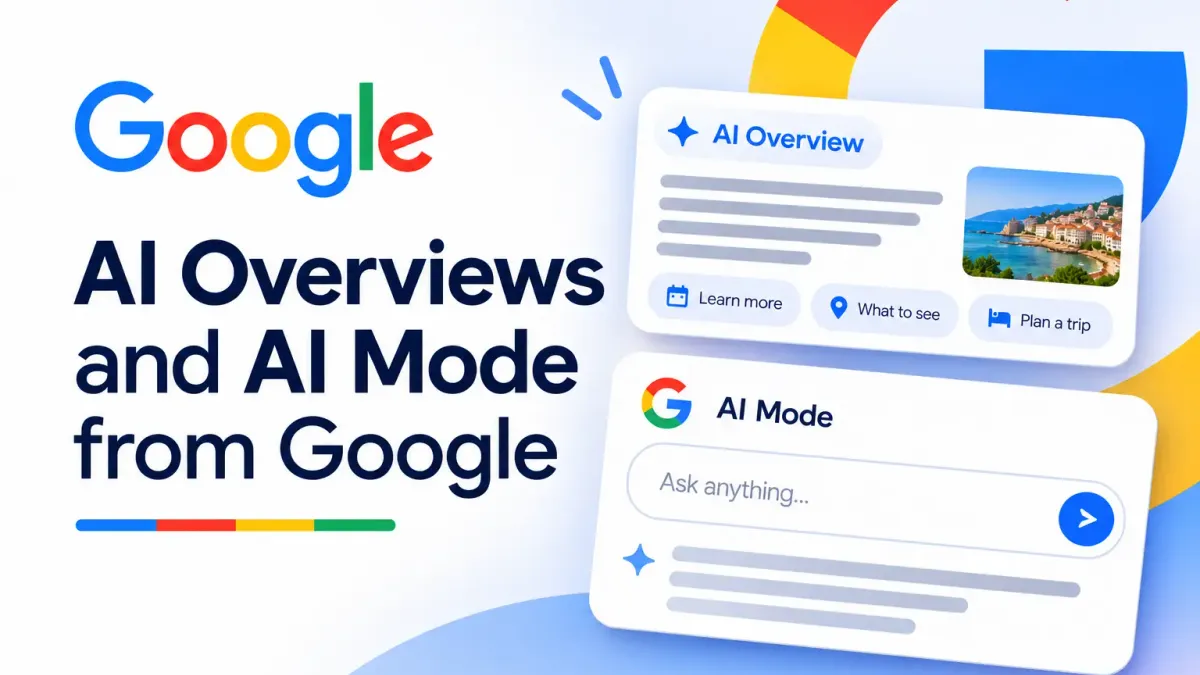
Google is changing the way it shows results. What used to be a list of ten blue links can now include a panel where artificial intelligence answers the user directly, often without them needing to click on anything. If your organic traffic strategy is still built only for the traditional model, it’s worth reviewing.
In this article we explain what AI Overviews and AI Mode are, how they can affect the clicks your site receives and what you can do to stay visible.
What are Google’s AI Overviews?
AI Overviews are AI-generated summaries that appear at the top of search results. Instead of just listing links, Google pulls together information from several sources and offers a direct answer, accompanied by links to the pages that support it.
For Google, the goal is to resolve the user’s intent as quickly as possible inside the results page itself.
What they look like in practice
Imagine you search for “how to get a red wine stain out of a white rug”. Instead of opening several blogs to compare methods, Google shows you a summary with concrete steps and, sometimes, links to articles or products. You get your answer without leaving the search engine.
What is Google’s AI Mode?
AI Mode is a deeper evolution: a conversational, interactive search experience where you can ask follow-up questions, refine your query and hold a dialogue with the AI inside Google’s interface.
Unlike AI Overviews, which appear as a block within the results, AI Mode turns search into a chat-style experience. It’s especially relevant for complex, comparison or research queries, where people need to explore several angles before deciding.
The impact on traffic: fewer clicks in some cases, not all
The question every marketing team asks is how much traffic is being lost. The honest answer is: it depends. Different studies suggest that when an AI summary appears, traditional results can receive fewer clicks, especially on informational searches. But the figures vary widely between studies, industries and query types, and Google maintains that links within these features get quality visits. That’s why it’s wise to distrust any single percentage and measure on your own site.
Why it can happen
- Instant satisfaction. People find the answer in the summary itself and feel no need to open any page.
- Zero-click searches. They’ve been growing for years, and AI-generated answers make them even easier.
- Resolution within a single session. With AI Mode, someone can settle complex questions by chatting, without visiting external sites.
But it’s not all negative
Not all queries are affected equally. Transactional searches, product comparisons, reviews and content with first-hand experience still generate visits. When the answer requires depth, authority or up-to-date data, there are more reasons for users to want to visit a specialist source.
What changes for websites
These features force a rethink of content strategy. Here are the most important changes.
1. Being a cited source, not just ranking
Ranking well is no longer enough as the only goal: it also matters that your page is one of the sources the AI links to. What helps is well-structured content with concrete data, examples and direct answers to common questions, in formats that are easy for a machine to read too (clear headings, lists, tables). There’s no guarantee of appearing, but it’s a solid base.
2. The value of real experience
Generic, rewritten or mass-produced content has little to offer against what an AI can already summarise. Articles with first-hand experience, real cases and original data are harder to replace. It’s what Google sums up as E-E-A-T: experience, expertise, authoritativeness and trust.
3. More qualified traffic
The total volume of clicks may drop on certain searches, but those who do arrive tend to come with a clearer need: to go deeper, compare or decide. That’s why conversion rate can hold steady or even improve with fewer visits.
4. New metrics
Looking only at ranking position falls short. It’s worth tracking:
- Impressions, clicks and CTR of your key pages in Search Console.
- Whether your brand is cited in AI Overviews and in answers from other AI engines, by manually checking your main queries.
- What people do when they arrive: time on page, scroll and conversions.
Strategies to adapt
Optimise to be understood and cited
- Answer key questions directly in the first paragraphs.
- Use an FAQ section with real answers.
- Include data, examples and concrete cases.
- Add structured data that describes what’s really on the page. It isn’t a requirement to appear in these features, but it helps the content be interpreted correctly.
Bet on content with your own experience
Tutorials with your own photos, analyses based on real data, well-founded opinions and case studies are much harder to replicate and therefore more valuable.
Diversify your traffic sources
Don’t rely on organic SEO alone. Complement it with email marketing, social media, communities and video. And add GEO (Generative Engine Optimization), which aims for your brand to be recommended by conversational engines: we explain it in GEO: how to get ChatGPT to recommend your brand.
Strengthen technical SEO
A fast, well-structured site with good architecture is more likely to be crawled and indexed properly, and being in the index is the requirement to appear in any Google Search feature. If you don’t know where to start, see what technical SEO is.
How to control the use of your content
If you don’t want your content shown in these features, Google offers snippet controls: nosnippet, data-nosnippet and max-snippet, as well as noindex. Keep in mind that limiting snippets also reduces how Google shows you in regular results. And that blocking Google-Extended in robots.txt doesn’t affect Search or AI Overviews: it controls use with Gemini.
AI Overviews and AI Mode aren’t a passing change: they’re a new layer in search. But useful, clear content with real experience is still what works best, there too.
If you want to make sure your brand is present both on Google and in the new AI engines, take a look at our SEO, GEO & AI service and write to us.