




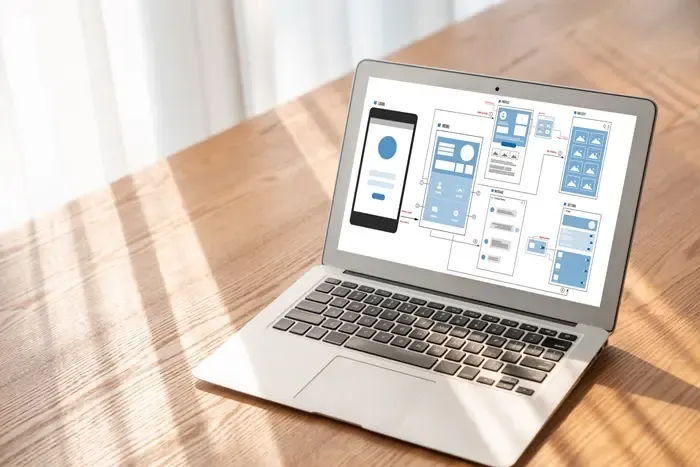
When someone says “web design”, most people think of colors, typefaces and nice photography. That’s an incomplete definition. Web design is, first and foremost, a problem-solving discipline: it solves how a user finds what they’re looking for, how they come to trust what they see, how they complete an action without getting frustrated and how they come back because the experience was a pleasant one.
Aesthetics are the wrapper. The essence is function.
The essence of web design: communicate, guide and convert
Web design exists at the intersection of three disciplines: graphic design, user experience and technical development. None of the three, on its own, produces good web design.
- Communicating means the site conveys who you are, what you offer and why people should choose you. A design that doesn’t communicate is decoration.
- Guiding means the user knows where they are, what they can do and what the next step is. A design that doesn’t guide is a maze.
- Converting means the site is built so the visitor takes an action: buy, get in touch, subscribe or request a demo. A design that doesn’t convert is a brochure.
These three goals are neither optional nor interchangeable. A site that communicates but doesn’t guide frustrates the user; one that guides but doesn’t convert is a dead end; and one that converts but doesn’t communicate creates distrust. If you want to see how this plays out in a concrete project, read Strategic web design: more than visual beauty.
The characteristics that define good web design
1. Clarity over originality
The most common mistake of novice designers is prioritizing originality over clarity: they want to surprise, innovate and break the mold, and in the process they confuse the user. Good web design prioritizes the user understanding. If visitors have to think to understand your menu, the design has failed.
Originality is valuable when it doesn’t sacrifice comprehension. A button should look like a button and a link should look like a link: conventions exist because they work. This is the territory of web usability.
2. Visual hierarchy
The human eye doesn’t read a page linearly: it scans it and looks for anchor points, such as headlines, images and buttons. Web design uses visual hierarchy to direct that scan toward what matters. Size, color, contrast, white space and position are the tools: a large headline draws attention before a small paragraph, a contrasting button stands out against a neutral background and white space separates sections and lets the content breathe.
Without hierarchy, everything competes for attention and nothing wins it.
3. Consistency
A site with ten button styles, five different typefaces and colors that change in every section conveys disorder and a lack of professionalism. Professional design establishes a system: a limited color palette, a coherent type scale and reusable components.
Consistency isn’t monotony, it’s coherence: users learn how your site works on the first page and apply that learning on all the others.
4. Responsive and mobile-first design
A large share of web traffic comes from phones, and Google takes the mobile version of your site as the reference for indexing and ranking it. Designing only for desktop is designing for a minority. The current approach is mobile-first: design first for the smallest, most restrictive screen and then scale up. That forces you to prioritize, and that decision benefits the desktop version too. We cover it in What is a responsive page.
5. Speed as a design decision
Speed isn’t just a developer’s problem: it’s a design decision. Every image added, every custom typeface loaded and every animation implemented has a cost in milliseconds.
Good design is aware of that cost: it optimizes images, limits fonts to two or three, uses animations in moderation and prioritizes critical content. Speed isn’t something added at the end, but something respected from the start. If you want to diagnose it, start with My website is slow: what can I do?.
6. Accessibility
Professional web design makes sure people with visual, motor or cognitive disabilities can use the site without barriers. That includes sufficient contrast, alt text on images, keyboard navigation, semantic tags and forms with proper labels.
Accessibility isn’t an extra feature: it’s a characteristic of well-done design. And it has a side benefit, because accessible sites are better for all users and for search engines.
7. Clear calls to action
Every page has a purpose, and design makes it explicit with calls to action that are visible, specific and repeated at the right moments. A vague one (“Submit”, “More information”) doesn’t communicate; a clear one (“Request a quote”, “Download the free guide”) tells the user exactly what they get if they click. On pages built for a campaign this matters even more: we look at it in What is a landing page.
8. Consistency with the brand
Web design doesn’t live in a vacuum: it’s the digital expression of a brand. Colors, typefaces, tone of communication and images must be consistent with the brand’s identity across all channels. A site that doesn’t reflect the brand creates a disconnect: someone arriving from a social media campaign should recognize the same visual personality.
What web design is not
It’s just as important to be clear about what it isn’t:
- It isn’t just aesthetics. A beautiful site that doesn’t convert is a design failure.
- It isn’t decoration. Visual elements aren’t there to fill space: each one serves a function.
- It isn’t a template applied without judgment. Buying a theme and changing the logo isn’t designing, it’s configuring.
- It isn’t a project that ends on launch day. Web design is a continuous process of measuring, learning and improving, which is why it’s worth keeping it up to date, as we explain in The importance of modern, up-to-date web design.
Aesthetics are what you see; design is what makes someone stay, understand and act.
If you want your site designed with this approach, at Web Design we think it through starting from your business goal, and for a reference on the investment, see How much does a website cost in 2026?.